
Searching Clay County Criminal Dockets
Start your docket search at Kansas CaseSearch. Pick District. Choose Case Number or a supported name search, and set the county to Clay County. Then apply the Criminal case-type filter so the results stop drifting into civil matters. A complete number like CY-2026-CR-000001 beats a common name every time. Read the segments for what they are. CY marks Clay County. And CR marks a criminal case type.
Use every documented Clay County channel rather than trusting a single screen:
- Search the official state portal with Clay County selected.
- Check the Clay County rolling docket for an upcoming public setting.
- Call or visit the Clay County Clerk of the District Court to confirm a recent Clay County setting change.
- Use the Clay County courthouse public terminal when Clay County public information is not online.
- Submit the Clay County records form by its stated route for a complaint, order, disposition, or certified copy.
A mailed Clay County records request needs the county's $12 prepayment before any search starts. Include the case number, the document title, the date, how many copies you want, and whether you need certification.
Clay Criminal Codes Need Context
A case number finds the file. It says nothing about the outcome. The code CR signals a criminal category, and TR signals district traffic. Municipal citations may never enter the district docket search at all, though an appeal can move a case onto the district route later. Older files sometimes carry a legacy number that doesn't match today's Odyssey format, so don't assume a mismatch means the case doesn't exist.
- Arraignment
- A stage when the charge is presented and a plea process occurs.
- Pretrial
- A setting used to address readiness, motions, and other steps before trial.
- Disposition
- The recorded resolution of a charge or case.
- Continuance
- A court-approved move of a scheduled event.
- Expunged
- A record subject to statutory limits and restricted public access.
Read a Clay County setting label literally. Status conference, pretrial, jury trial, and Drug Court are event labels in the court docket. They prove nothing about what happened or how the case ended.
Inside a Clay County Criminal Docket
The public Clay County criminal docket is an event trail. It is not the full evidentiary file. Use it to identify the case and to request the exact court records you need, keeping in mind that some entries carry no viewable document and protected items stay sealed off.
| Case number | The Clay County, year, criminal type, and sequence identifier. |
|---|---|
| Charge entry | The filed accusation as reflected in the public index; it is not proof of guilt. |
| Setting | An arraignment, status, pretrial, trial, sentencing, or other scheduled event. |
| Motion event | A filing or ruling entry that may require a document request for its full terms. |
| Disposition | A dismissal, plea, trial result, diversion-related outcome, or other entered resolution. |
| Judge and connection | The assigned judicial officer and any listed in-person or remote detail. |
Don't expect the internet view to hold everything. The complaint, the evidence, a sentencing order, and supervision terms may all sit outside it. Ask the Clay County clerk for a named public document instead of treating the docket index as the complete official record.
Clay Settings Are Not Dispositions
Updates run daily, but the system warns that a freshly processed continuance can lag. Any saved copy can be stale. When a hearing is close, compare the rolling list with CaseSearch and call the Clerk of the District Court at 785-632-3443. The clerk can confirm the current public setting, while the assigned judge's order still controls.
Read the line narrowly. A pretrial label means a pretrial event was set. It does not show a plea, conviction, dismissal, or sentence unless a later official entry records that result.
The same caution applies to specialty labels. Clay County calendar and county materials can explain Drug Court context, but they create no public participant list and reveal no treatment facts. Clay County Court Services runs supervision and program work; it does not hold the criminal case file.
How a Criminal Case Moves
A Clay County criminal docket can reflect several stages, though not every case follows the same path. The usual event trail can be read as: filing › arraignment › pretrial › plea or trial › disposition › sentencing. Diversion, dismissal, continuance, or another court order may change that sequence.
The Twenty-First Judicial District local rules add scheduling detail for Clay County. Felony trial dates are set at felony arraignment, and counsel come with calendars in hand. A motion to continue a preliminary hearing normally must be filed at least three days before the setting. A later one is allowed only for good cause. Motions to dismiss or suppress are generally due at least 30 days before trial. The court can order otherwise.
These are published rules, not the status of your case. The current rule and the judge's order govern. A docket search verifies what was filed, never what comes next.
Clay Criminal Dispositions by Number
For aggregate context, turn to the official Kansas FY2025 Criminal Dispositions report. For the year ending June 30, 2025, it counts 48 Clay County felony dispositions and 29 misdemeanor dispositions. Those totals describe outcomes across the county. They name no one, and they forecast nothing about a pending charge.
The felony row breaks into diversion-related outcomes, dismissals, guilty pleas, and other outcomes. It also includes one jury trial. The misdemeanor row spreads across several categories plus one jury trial of its own. That spread is the lesson. No case number or charge label alone yields a conclusion. Only the entered disposition and its underlying order tell you how one case ended.
Courts That Hold Criminal Dockets
Clay County District Court holds the Kansas state felony and misdemeanor cases under its general trial jurisdiction, with district magistrate judges serving inside the same structure. A municipal court keeps its own city ordinance and ticket matters unless an appeal or another procedure pulls them into district court. Check the court printed on your notice first. That is your routing clue.
A federal case tied to Clay County lives elsewhere. The U.S. District Court for the District of Kansas offers the official federal route, fully outside the Clay County system, and its site shows how that court works.
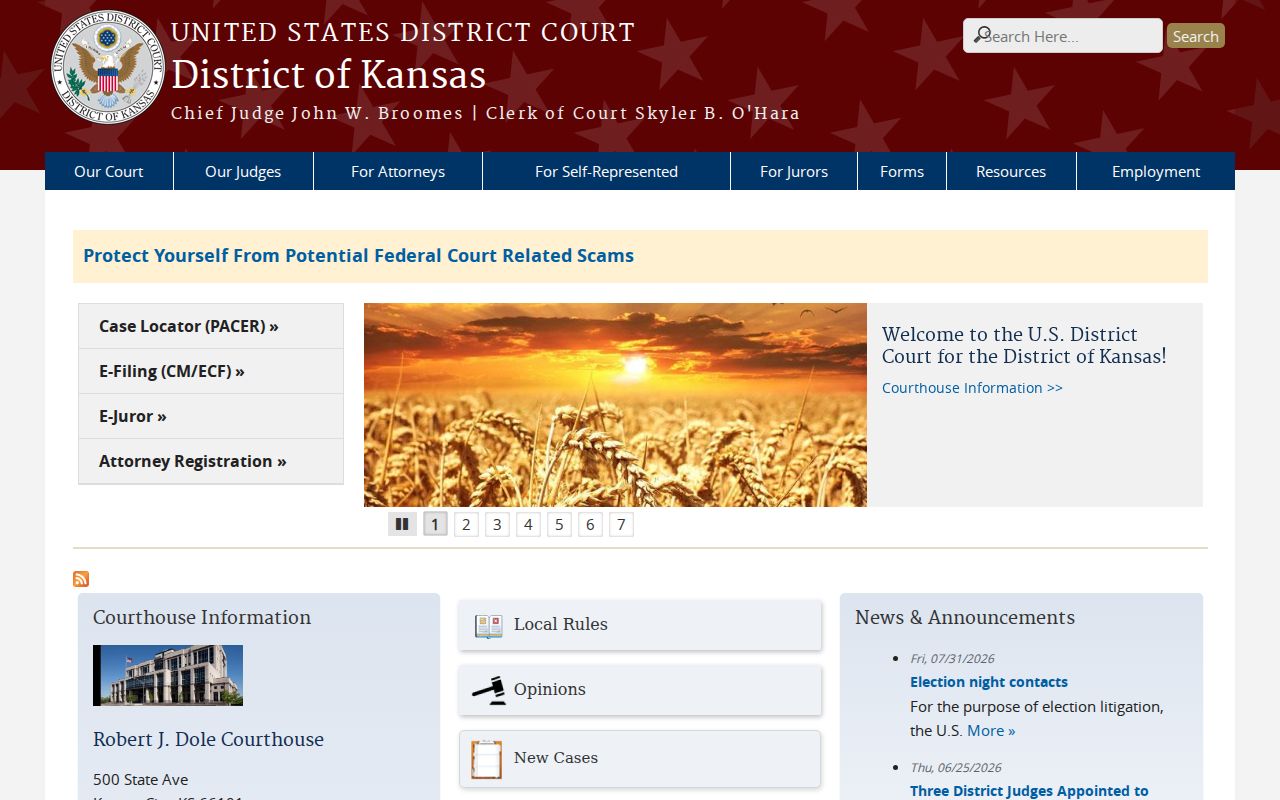
That source connects federal court information and PACER, not the Clay County district CaseSearch.
For filings, the District of Kansas CM/ECF system is the federal environment. It is not a Clay County filing tool.
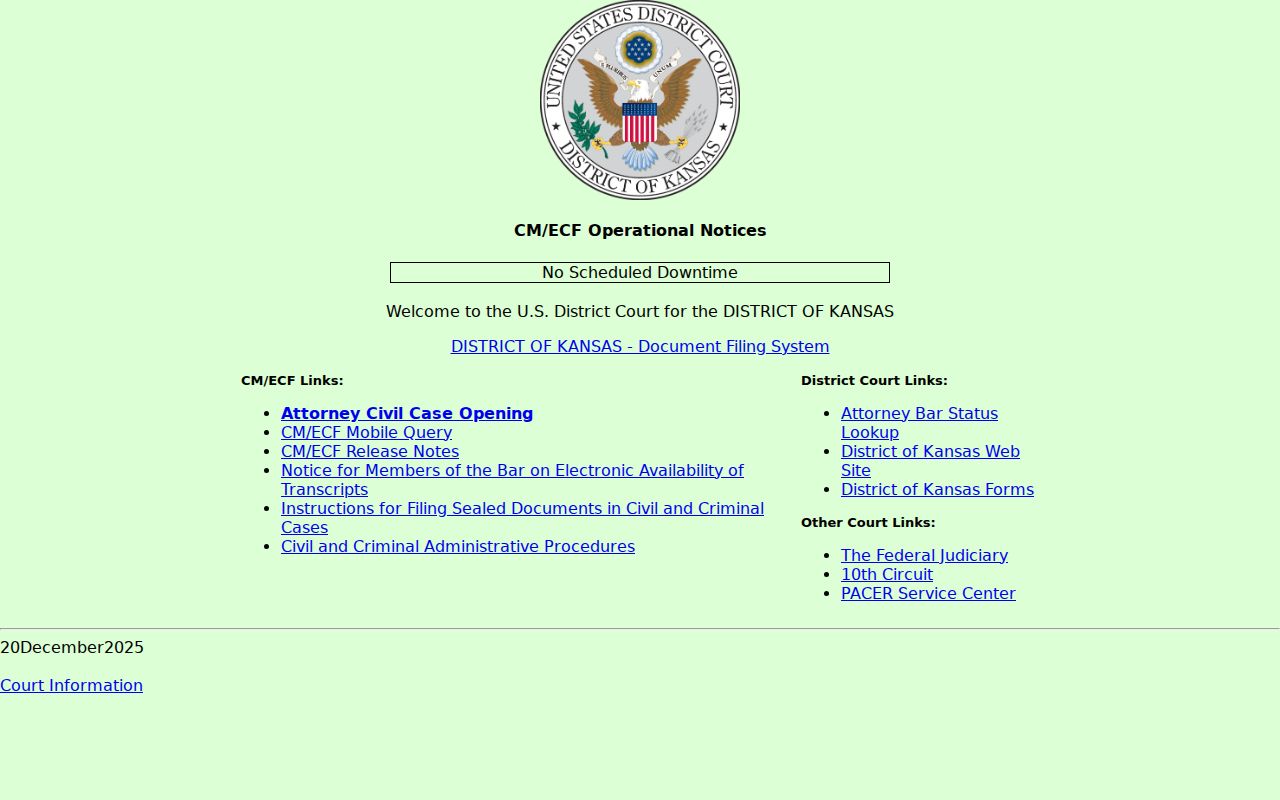
A federal search usually starts with PACER, and CM/ECF handles the federal side of docket and filing work. Neither one carries a Clay County District Court record.
Clay Court Services Is Separate
Clay County Court Services runs programs in both Clay and Riley Counties. Its duties span adult and juvenile supervision, reports, bond supervision, community service, work release, house arrest, and service referrals. Plenty of that work touches criminal cases. Even so, the office is not the Clerk of the District Court, and it does not hold the docket or the case file.
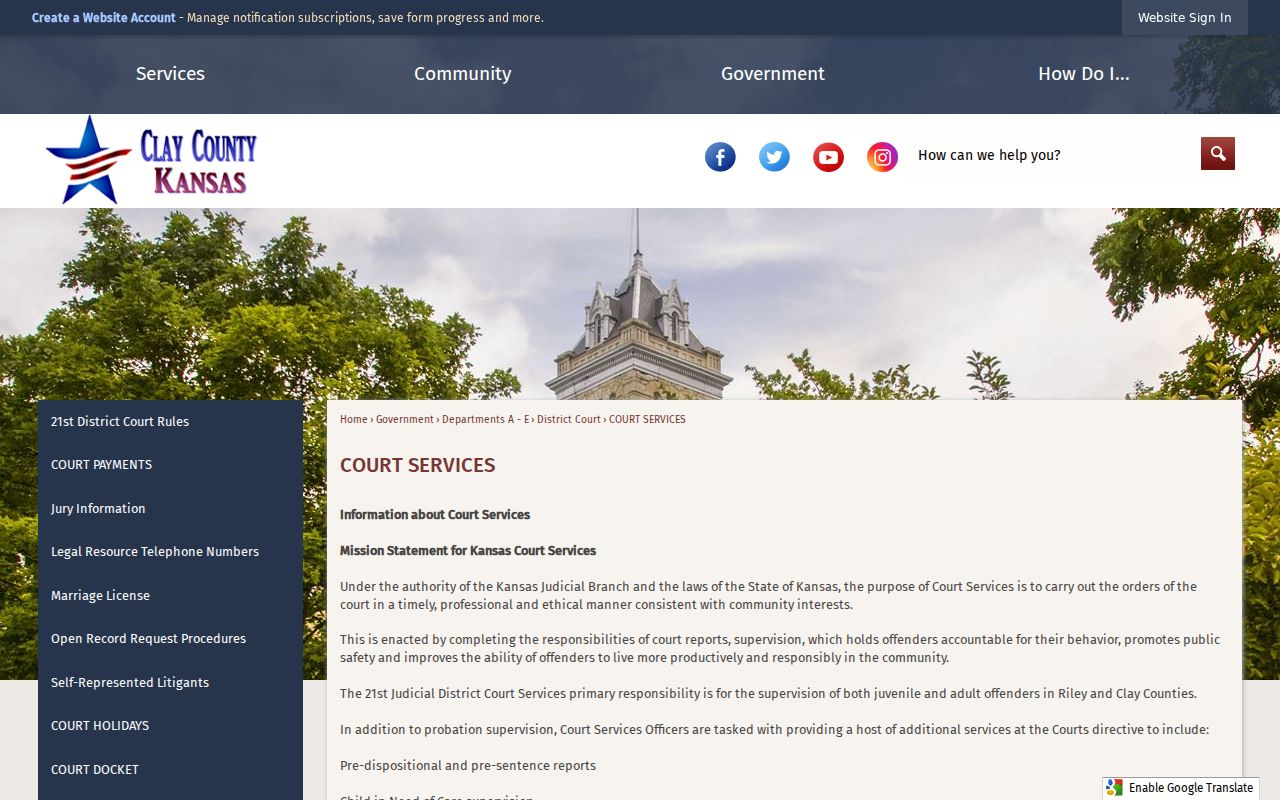
That Clay County office is the right stop for program questions, but an ordinary record request sent there will just bounce back to the wrong desk. The district clerk is the office for a Clay County journal entry, complaint, disposition, or certified copy. Federal records belong to the federal system. A Clay County city citation goes through the municipal court first, once you identify it. Keeping these custodians straight saves you from reading a false dead end as a true no-result.
Sealed Dockets and Public Access
Kansas Supreme Court Rules 21, 22, and 106B draw a line between the public events index and the full case file in Clay County. Rule 22 keeps certain categories off the internet, among them juvenile, child-in-need-of-care, protection, expunged, grand-jury, adoption, and care or treatment matters. A document can stay nonpublic even when the basic index still shows the case.
Access boundary: A sealed label, masked name, or unavailable document is not an invitation to search around the restriction. Ask the clerk whether a public portion exists.
Kansas Supreme Court Rule 22 governs key electronic access limits, while Rule 24 addresses protection of personal identifiers.
K.S.A. 45-218 gives Clay County a general framework for requesting records. It cannot override a sealing order, a court rule, or a nonpublic category. When a request is denied in whole or in part, ask which authority applies and whether any public material can be split out. Keep your terms neutral, too. Words like charge, accusation, setting, filing, and disposition should match what the Clay County source actually says.
Confirm Clay Criminal Records
The official trail ends at the Clerk of the District Court. That office sits at 712 5th Street, Suite 204, Clay Center, Kansas 67432. The Clay County request form includes a Criminal/Juvenile/Traffic category. It asks what you want: a useful description, copies, or certification. Expect to pay $12 before the search begins. The clerk can quote any copy, certification, postage, or large-request fees beyond that. Ask for one identifiable item when you can. Think a complaint, journal entry, disposition, sentencing order, or register of action. Give the Clay County case number and an approximate date. The courthouse public terminal also allows public search access. Older files may still need clerk help, since the switch from FullCourt to Odyssey left some historic documents off the internet. For a wider name or number workflow, the Clay County Case Lookup page walks through the portal fields. Verify everything with the originating court or clerk.