
Searching the Clay County Court Docket
Every Clay County docket search starts with one question: which court holds the case? Felony, civil, family, probate, juvenile, and small-claims matters sit with the Clay County District Court. City ordinance violations and municipal tickets can stay with a city court instead. Appeals and federal cases live in entirely separate systems. Before you search, grab the full case number if you can. A name alone often pulls up several matches.
Work the available Clay County channels in this order:
- Open Kansas CaseSearch, choose District, and filter for Clay County.
- Search the Clay County index by full case number, citation number, or party name.
- Compare events with the Clay County rolling docket.
- Confirm a time-sensitive Clay County setting by phone or at the clerk's counter.
- Use the Clay County form and mail or email route for a specific document.
The public terminal at the Clay County courthouse can display material that never makes it online. For an official or certified copy, a request to the Clay County clerk is still the correct route.
Clay County District Docket Sources
Two state-side tools cover Clay County. Kansas CaseSearch works as a statewide index, while the Clay County rolling docket lists near-term settings and warns that a continuance processed yesterday may not show up yet. Treat neither as the full court file. The official rolling docket page comes straight from the Clay County source and posts the current settings.
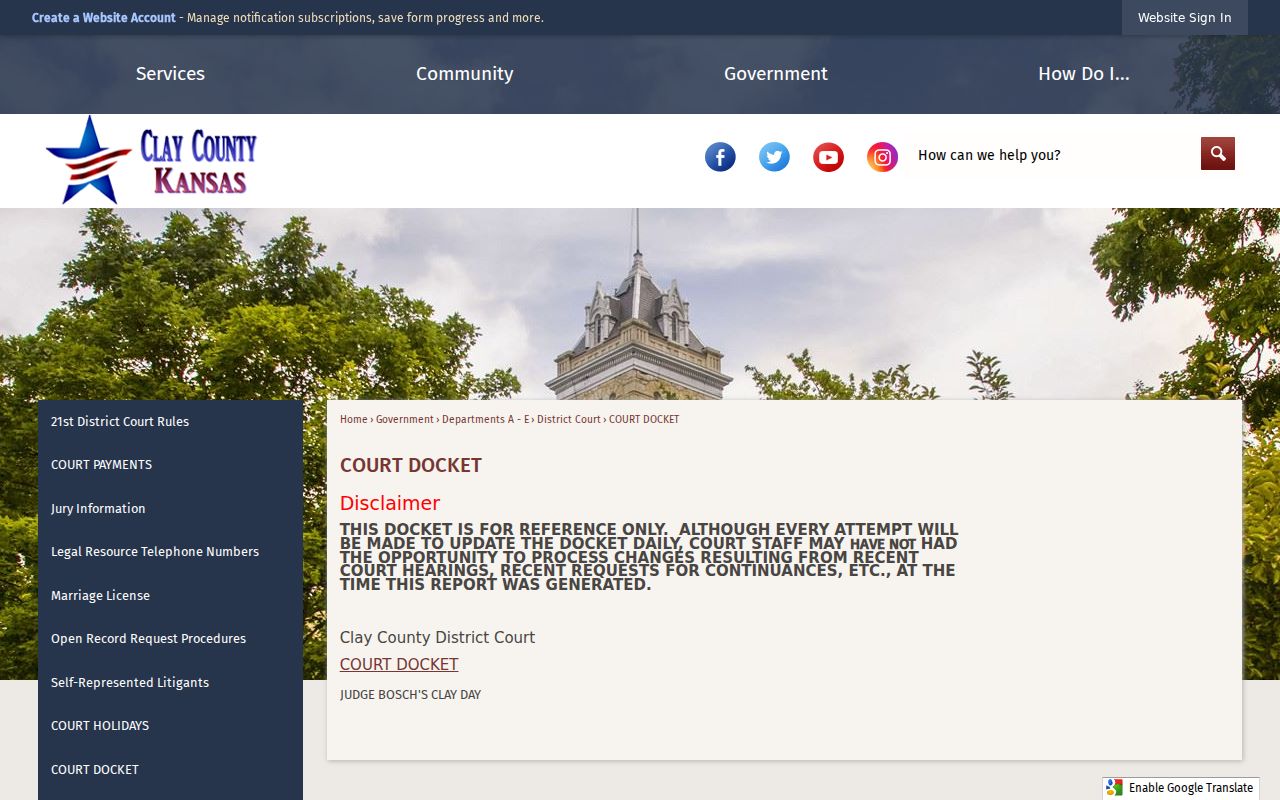
Use the rolling list for planning only, then have the Clay County clerk confirm anything recent. For district-wide context, the Twenty-First Judicial District site covers the courts that serve the county.
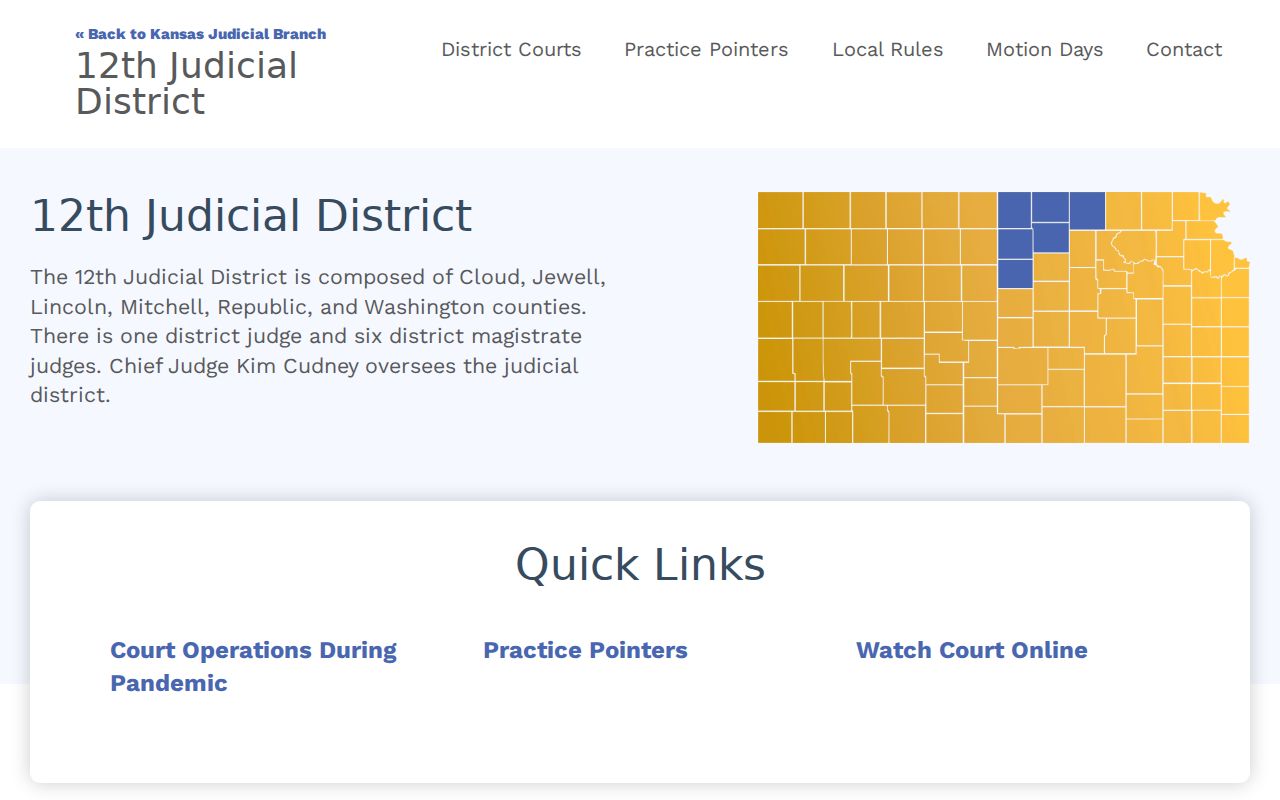
The district covers more than Clay County alone. Even so, a docket search only turns up the right cases when you apply the Clay County filter.
Inside a Clay County Court Docket
A Clay County docket lists events, not a story. Codes and settings help route your case lookup, but they prove nothing about guilt, liability, judgment, or payment.
| Case number | CY-2026-CR-000001 shows county, year, type, and sequence. |
|---|---|
| Setting | A scheduled status, pretrial, trial, small-claims, or specialty event. |
| Date and time | The listed setting, subject to later court action. |
| Judge or connection | The judicial officer and any shown remote detail. |
| Event index | Filing activity without every document's contents. |
| Disposition | A result only after it is entered. |
A sealed marker or masked field on a Clay County docket marks an access boundary. Never reconstruct the hidden detail from the Clay County entries around it.
Read Clay County Case Codes
In current Odyssey-style numbers, CY marks Clay County. Common case-type codes include CR for criminal, TR for traffic, LM for limited action, and SC for small claims. Older files can carry legacy number shapes.
- Register of action
- The case event index, not the full file.
- Setting
- A scheduled event, not necessarily a trial.
- Continuance
- A move to another date by court action.
- Sealed
- Material withheld under a rule or order.
When an old Clay County number fails, copy the exact text from your notice. The Clay County clerk can sort out which format the older case uses.
Courts That Keep Dockets in Clay County
The court named on your notice decides where to look. Clay County District Court serves as the general trial court, while city courts, Kansas appellate courts, and federal court each keep their own records.
| Court | Covers | Search route |
|---|---|---|
| Clay County District Court | State civil, criminal, family, probate, traffic, and small claims | CaseSearch, county docket, terminal, clerk |
| Municipal court | City ordinances and some tickets | Issuing city court |
| Kansas appellate courts | Appeals | Appellate public access |
| U.S. District Court | Federal matters | PACER and CM/ECF |
The Clay County court source documents the local role.
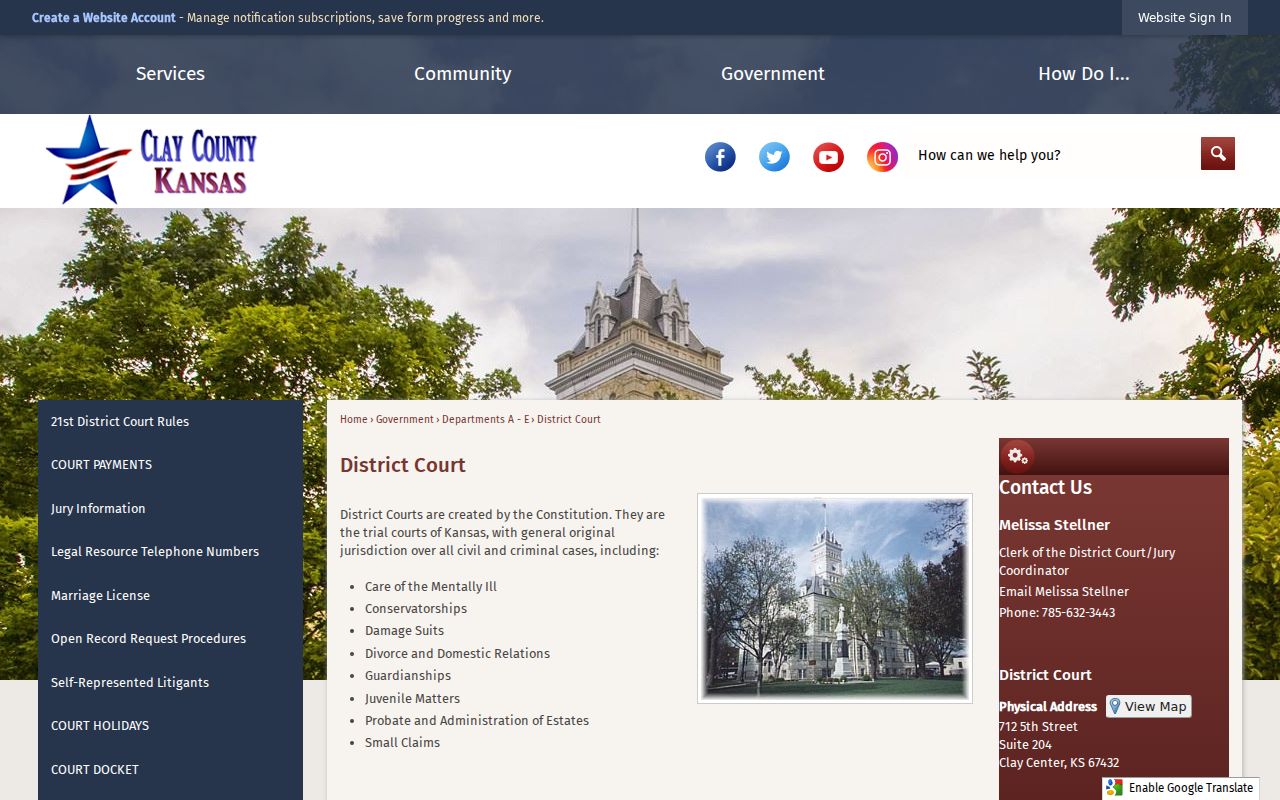
That official Clay County page is the best starting point for current Clay County links.
Clay County Clerk Offices Differ
District cases belong with Melissa Stellner, Clerk of the District Court and Jury Coordinator. She is the Clay County contact for docket questions. The Clay County Clerk is a separate office. It handles county administration. Complaints, orders, dockets, and certified court records all route through the district clerk. The Clay County court directory lists the official staff contacts.
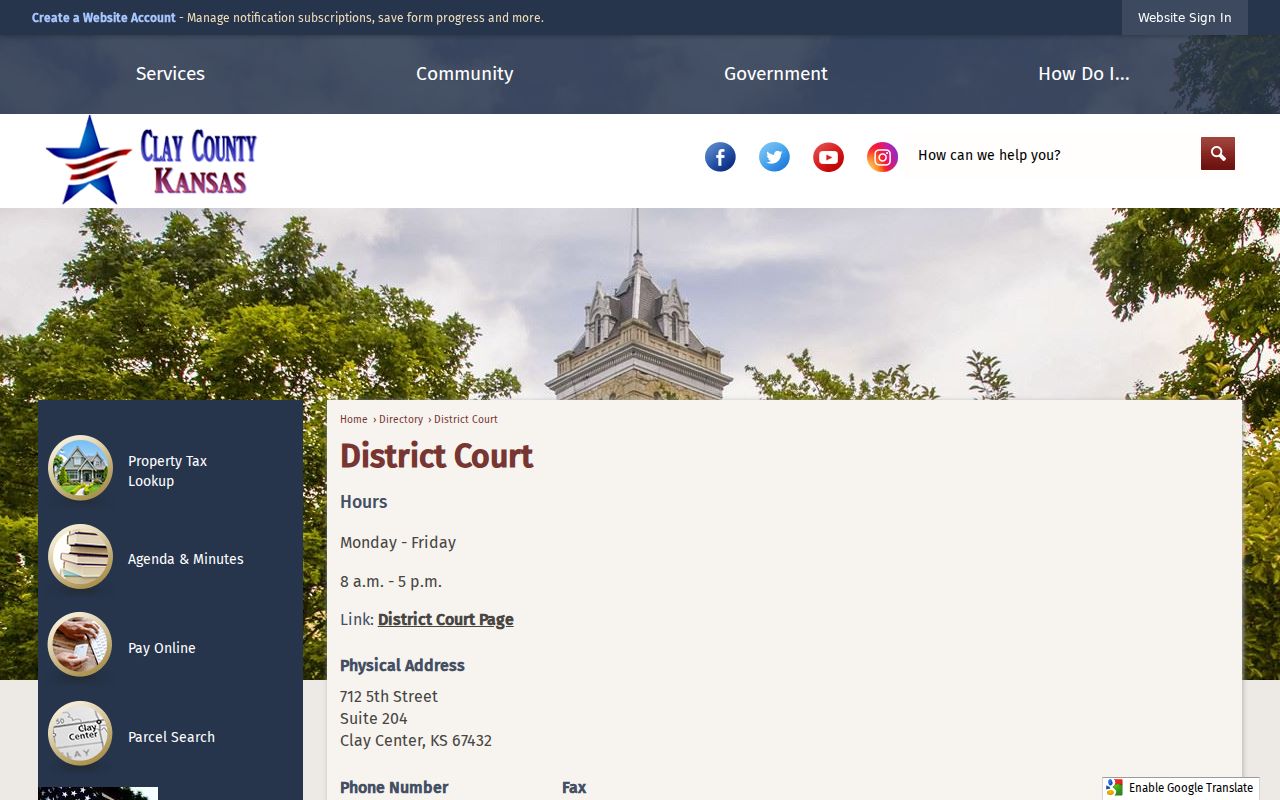
This Clay County distinction keeps a court-record request from going to the wrong office.
How to Find Court Dates and Settings
Read the whole Clay County setting together: date, time, setting type, judge, connection, and case number. Then cross-check Kansas CaseSearch against the Clay County rolling docket. The Kansas Self-Help Center posts a next-seven-days calendar. The state can also send Clay County hearing reminders.
Hearing close, or sources disagreeing? Call the district clerk at 785-632-3443. The county warns that a recent continuance may not reach the posted list right away. The full workflow sits under Clay County Court Dates.
Note: a Clay County setting shows scheduled work, not the merits or result of the case.
Clay County Docket Technology Changed
Clay and Riley Counties joined the Kansas eCourt and Odyssey shift in 2019. Kansas later rolled out CaseSearch. It moved current Judicial Branch pages to its .gov web presence. So older guides can point to retired addresses or number formats that no longer apply.
The current official portal and the Clay County clerk bridge that gap. A missing result can mean a legacy format. It could also mean the wrong court, a protected case, or an older file needing a courthouse search. It does not prove no Clay County case exists.
Public Access to Court Dockets
What you find online is narrower than the full Clay County court file. A courthouse terminal may show more public detail, though sealed and nonpublic material stays off limits either way.
Key rules:
Rule 21 defines the portal, case record, and register of action.
Rule 22 sets access limits for protected cases and documents.
Rule 106B governs electronic records and terminals.
K.S.A. 45-218 supplies the general request framework.
Some categories stay closed. Clay County adoption files, certain juvenile and protection matters, expunged cases, and grand-jury material may all be unavailable. When in doubt, ask the Clay County custodian about the legal basis and whether a separable public portion exists.
Clay County Official Record Limits
CaseSearch serves as a general reference, not the official Clay County record. An index can skip nonpublic documents. A docket line rarely explains how a hearing ended. For the real answer, request the exact Clay County order, judgment, complaint, or disposition from the clerk. The Kansas Judicial Branch site is the current state gateway.
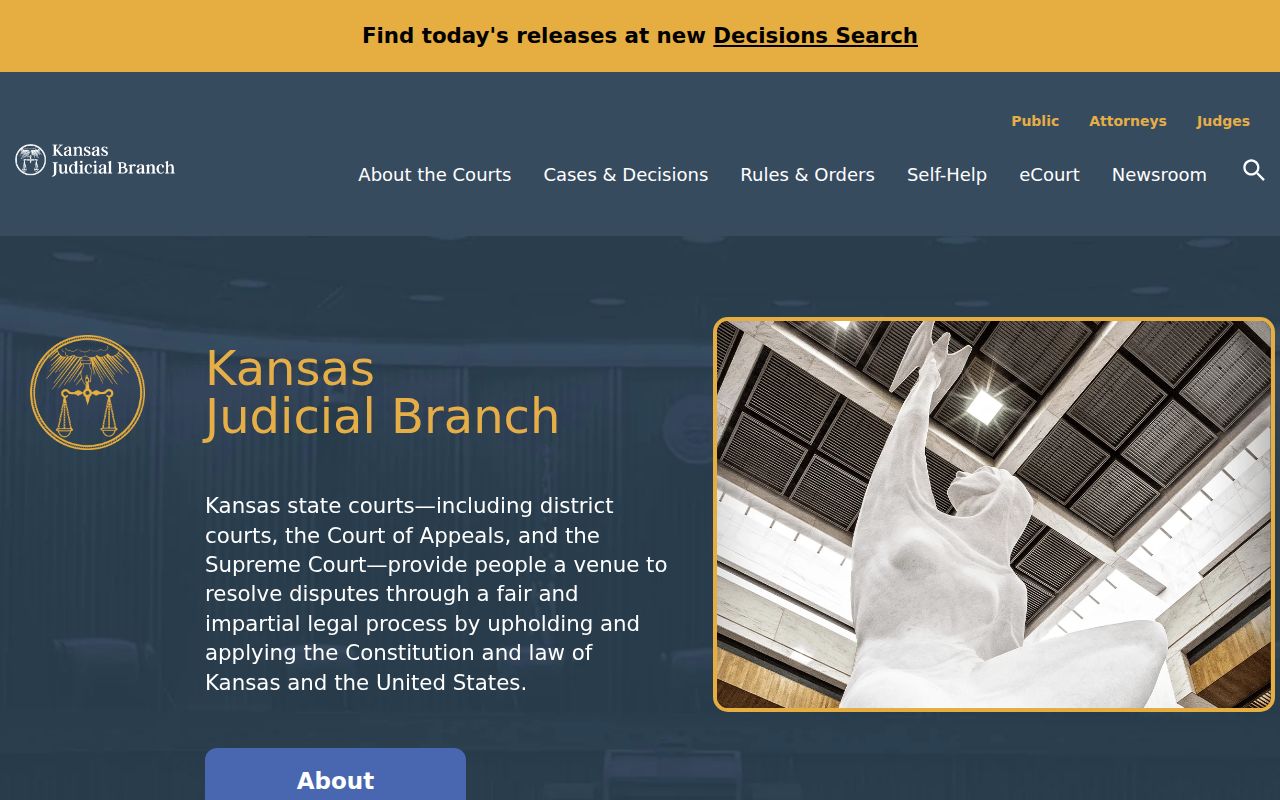
The official gateway distinguishes current Clay County systems from retired links and unofficial copies.
Docket Records at the Clerk's Office
The Clay County form sorts requests by type. Options include criminal, juvenile, and traffic; probate; domestic; civil and limited action; and other records. Give the case number, the document, the date, and how many copies. Say whether you need certification. Under the Clay County procedure, $12 is due before the search begins. The county does not post its other copy, certification, mail, or large-request fees.
Clerk of the District Court
712 5th Street, Suite 204
Clay Center, KS 67432
785-632-3443
The certified population source adds county context.
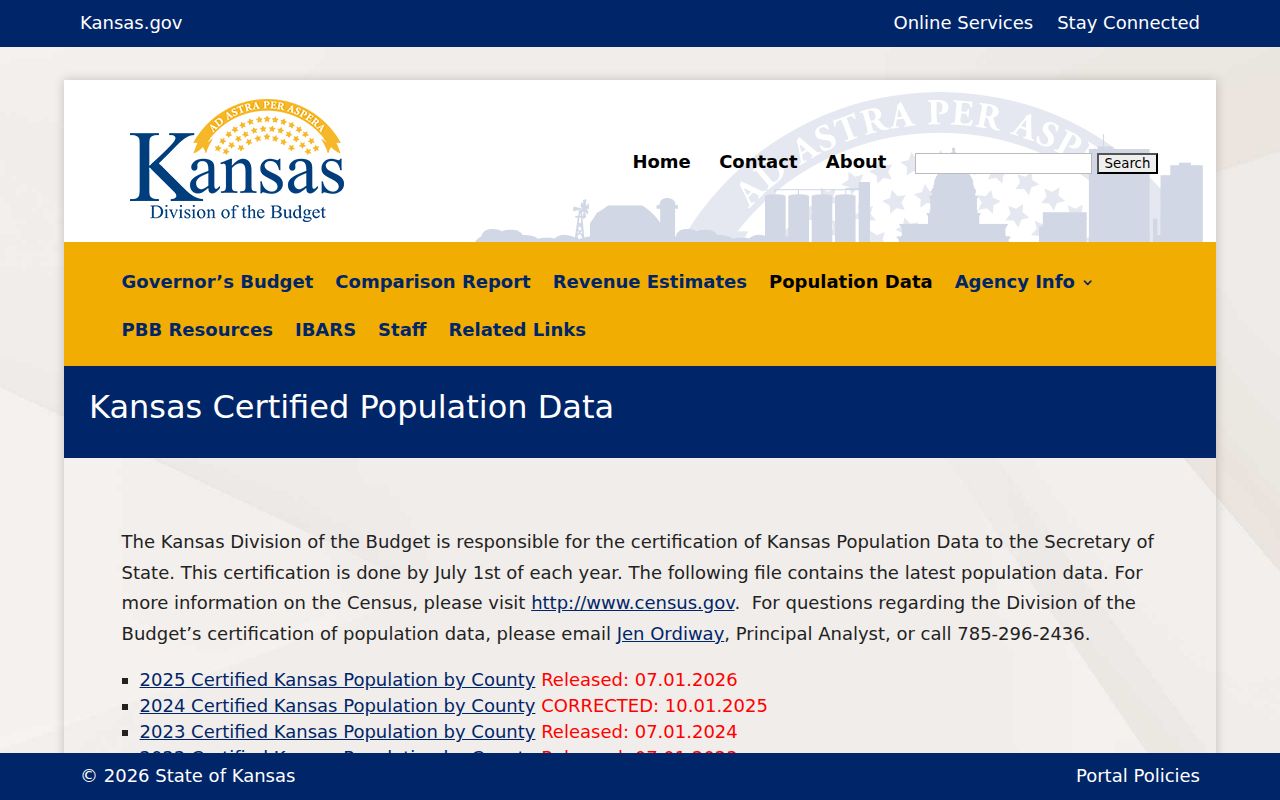
Clay County population does not measure Clay County docket volume or identify court users.
Clay County Courthouse Context
Official sources place the Clay County Romanesque courthouse at 1900 and 1901. The district clerk works from the second floor. Age does not equal access, though; a historic building can still hold old files that were never digitized. The historic register records that setting.
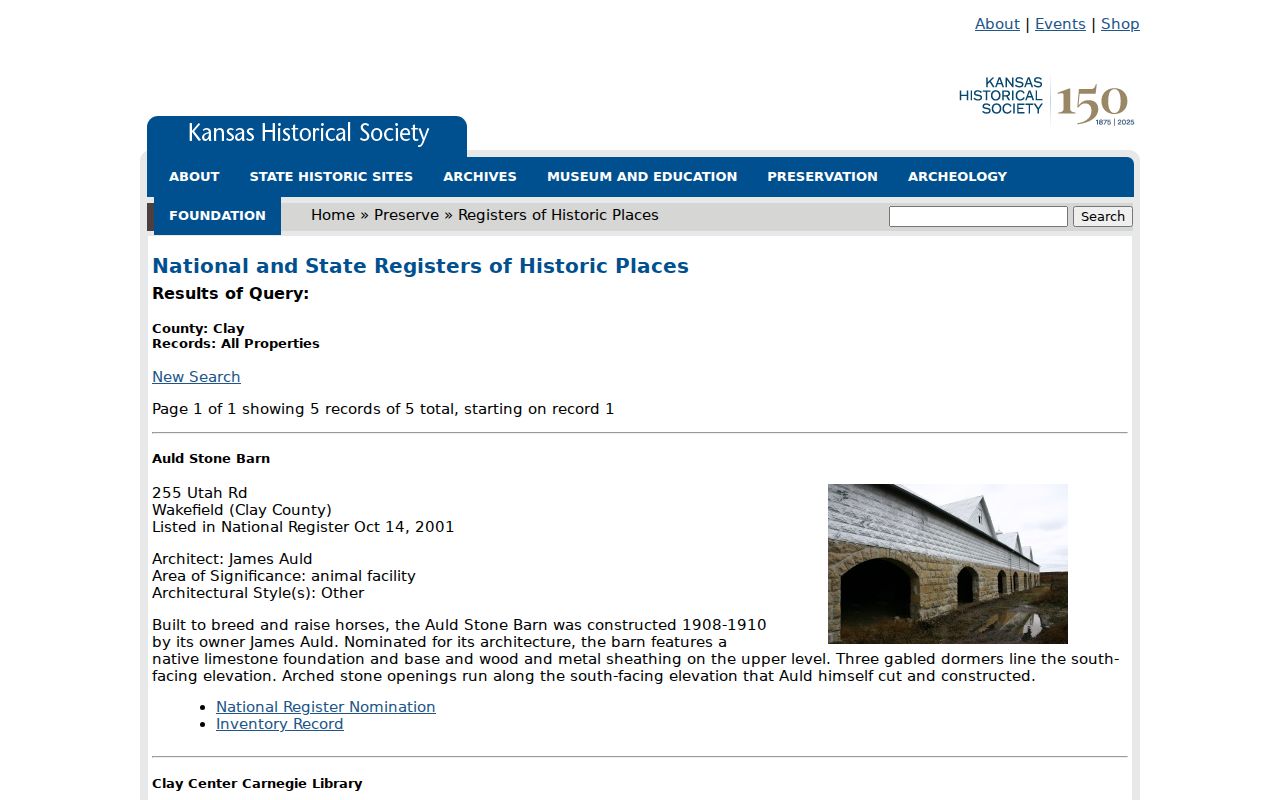
When the web falls short, the courthouse terminal and the Clay County clerk's file fill the gaps. The county geography source adds place context.
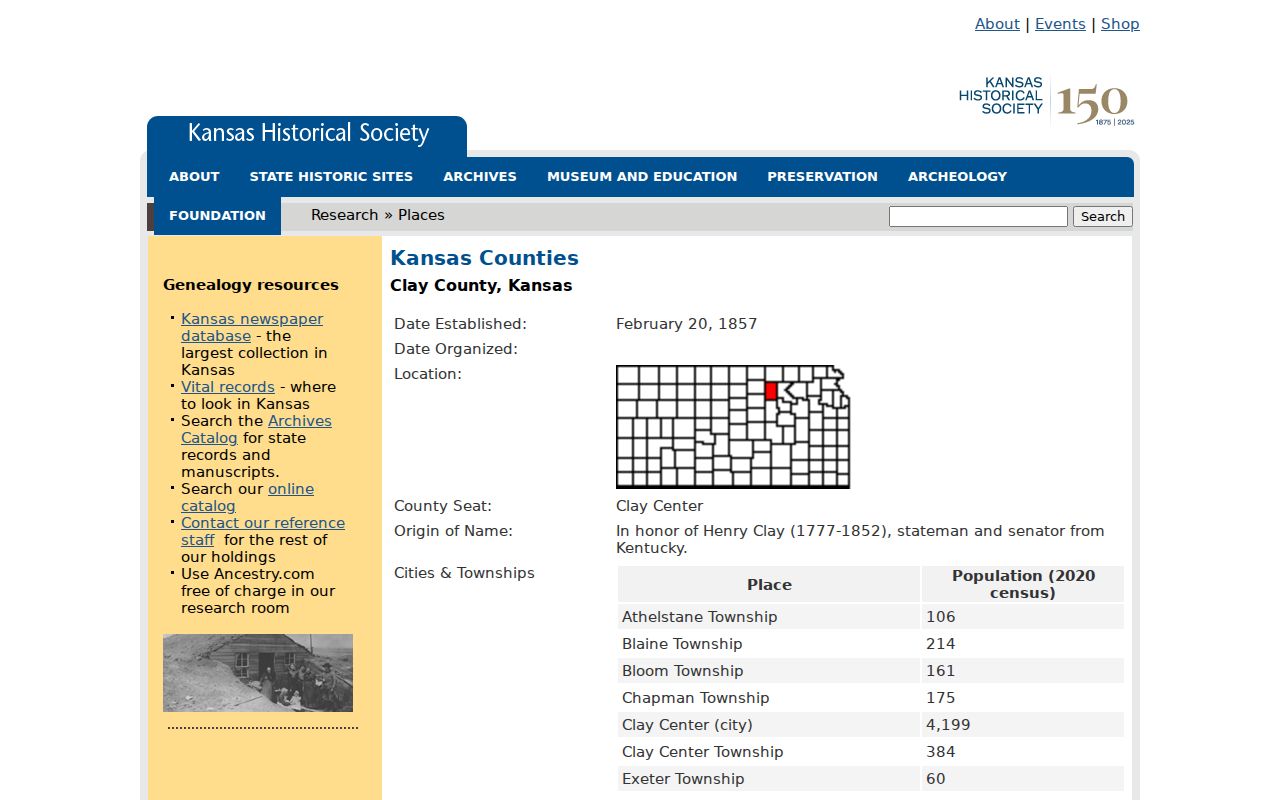
Clay County geography matters because municipal, district, and cross-county cases use different routes.
Clay County Docket Scale
The numbers give a sense of scale. Reports list 48 Clay felony and 29 misdemeanor dispositions for FY2025, plus 294 Clay civil filings for FY2024. Traffic reports show 262 filings against 299 dispositions. Filings and dispositions measure different things, and neither counts unique people.
One number needs context. The district-wide caseload of 6,441 covers Clay County and Riley County together, so treat it as a joint figure rather than a Clay County-only count.
Clay County Court Dockets by City
Clay Center, Wakefield, Clifton, Morganville, and Green lead the 2020 Census ranking of incorporated places. Your city address does not pick your court. Clifton even straddles the Clay and Washington County line.
The county's communities index profiles each of these local places.
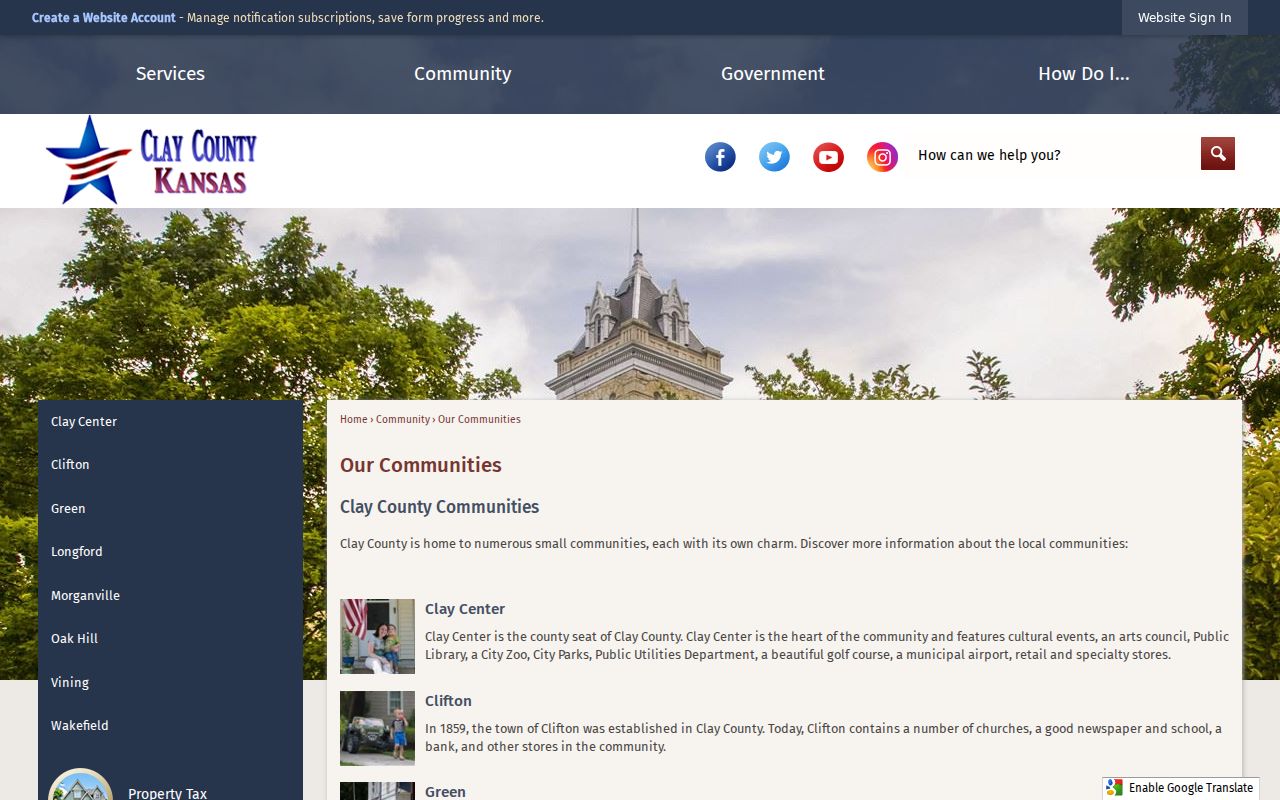
Do not assume equal online court tools across these Clay County cities.
Clay Center Docket Search
Clay County seat and Clay County district-court hub.
Wakefield Docket Search
Use the issuing court for Clay County city matters.
Clifton Docket Search
Confirm Clay County before searching.
Morganville Docket Search
District cases use Clay County sources.
Green Docket Search
Verify Clay County city details through an official contact.
Clay County Search Cross-Checks
Start with a careful name search. Kansas CaseSearch wants a last name paired with a first name for an individual. Wildcard searches carry their own minimum character rules. Businesses narrow best when you type enough characters. Date filters track filing dates, never hearing dates. So don't plug today's setting into a filing filter and read the results as a calendar. Pick the known case type. Keep Clay County as the county filter. Compare each possible match by full case number and filing context.
An event index and the court file answer different questions. The index confirms that a motion, an order, or a hearing was entered. The document itself may hold exact terms, findings, and signatures. When those details matter, ask for that one record by its title and date. A blanket demand for everything is slower to process and may sweep in protected material. A focused Clay County request gives the clerk a clear target. It also lets you say whether you want a plain or certified copy.
Case type routes a file; it decides nothing. A CR number signals the criminal category. A TR number marks district traffic. An SC line set for trial shows only a scheduled small-claims event, not any proof, award, or outcome. The same caution covers status, pretrial, Drug Court, and similar calendar labels. Treat each entry as a setting unless the official record supplies a result.
Clay Center's city-linked nCourt page takes payments for certain local tickets. It is not a searchable district docket. A state charge or a district appeal travels the district route instead. Federal matters usually stay out of Kansas CaseSearch. The U.S. District Court for the District of Kansas relies on PACER for public searches and CM/ECF for filing. Court Services sits apart as well. It handles supervision and program work, not the Clay County case file.
Kansas Courts eFiling through eFlex serves authorized filers only. It is not a backup public search. Filing access, guest portal access, approved expanded access, courthouse terminal access, and clerk-file access each stand as separate levels. A guest result with no linked document does not prove the document went unfiled. It may be unavailable online, restricted, older, or obtainable only through the court. The clerk can point to the next step without promising release of nonpublic material.
K.S.A. 45-221 lists the public-record exceptions. K.S.A. 45-222 supplies an enforcement framework. Court rules, statutes, and sealing orders still control. Clay County's request form carries a certification tied to K.S.A. 45-230, which bars prohibited commercial use of name and address lists. Public access serves court understanding, civic research, genealogy, and a person's own case needs. The clerk is not a bulk list service.
A final check is simple. Confirm the source is official, Clay County is selected, the number matches, and the displayed date is a setting rather than a filing filter. Note when you viewed the source. If two official channels conflict, call the Clerk of the District Court. For a municipal citation, use the issuing city court. For a filed order or certified disposition, request that exact document instead of trusting a calendar line.
Clay County Request Planning
Do the docket search first. Know which Clay County court holds the case. Get the full case number. A record request then becomes far simpler once those two facts are in hand. Jot down the number, the rough filing date, and the exact title of the paper you want. The county form asks you to pick a category: Criminal/Juvenile/Traffic, Probate, Divorce/Child Support/Custody, Civil/Limited Action, or Other. You also state how many copies you need. Say whether the record must be certified. With those details, the district clerk can pull one narrow file. A name alone won't pull everything attached to it.
Money comes first. Under the county's official procedure, the search does not start until the $12 payment arrives. No full fee schedule for copying, certification, postage, or oversized requests is published. Ask the clerk what else might be owed before assuming the prepayment is the whole bill. K.S.A. 45-218 requires prompt action under the Kansas Open Records Act and sets a third-business-day response framework. That framework does not promise the document in hand within three days. It also cannot override a court access rule that limits what the clerk can release.
Old files may take a trip. Kansas moved its district courts from earlier systems into Odyssey. But a technology change is not a promise that every historic Clay County filing is online. The public terminal at the courthouse can reach material the internet portal does not show. You can reserve it. A clerk can also tell you whether a file sits in other storage. The clerk can say whether a judge must review it first. And the clerk can say whether the document you named is nonpublic altogether.
Certification is its own checkbox. A screen print or a saved docket image is not a certified court record, no matter how official it looks. When you need proof that an order was actually filed, name that order and ask the clerk to certify it. When all you want is the next hearing date, check the rolling docket and confirm the setting before paying for a broad file. Matching the channel to the task saves money and keeps you from trusting an incomplete index.
Map and Directions to the Clay County Courthouse
Clay County District Court files are kept on the second floor, Room 204, of the courthouse at 712 5th Street in Clay Center, the county seat at the U.S.-24/K-15 junction. Clerk Melissa Stellner and Deputy Clerk Melissa Kling staff the Suite 204 office, which handles the docket/register of action, case-file confirmation, and records requests. The separate first-floor County Clerk at Suite 102 handles county administration and elections, not district-court files.
Clerk of the District Court
712 5th Street, Suite 204
Clay Center, KS 67432
785-632-3443
Monday-Friday, 8:00 a.m.-5:00 p.m.
The 1900-1901 Romanesque courthouse is on the National Register, but its history does not change access rules. A public terminal at the courthouse can show material beyond the internet portal, and a records request for a copy or search requires the $12 prepayment described in the county's official procedure before staff begin looking.